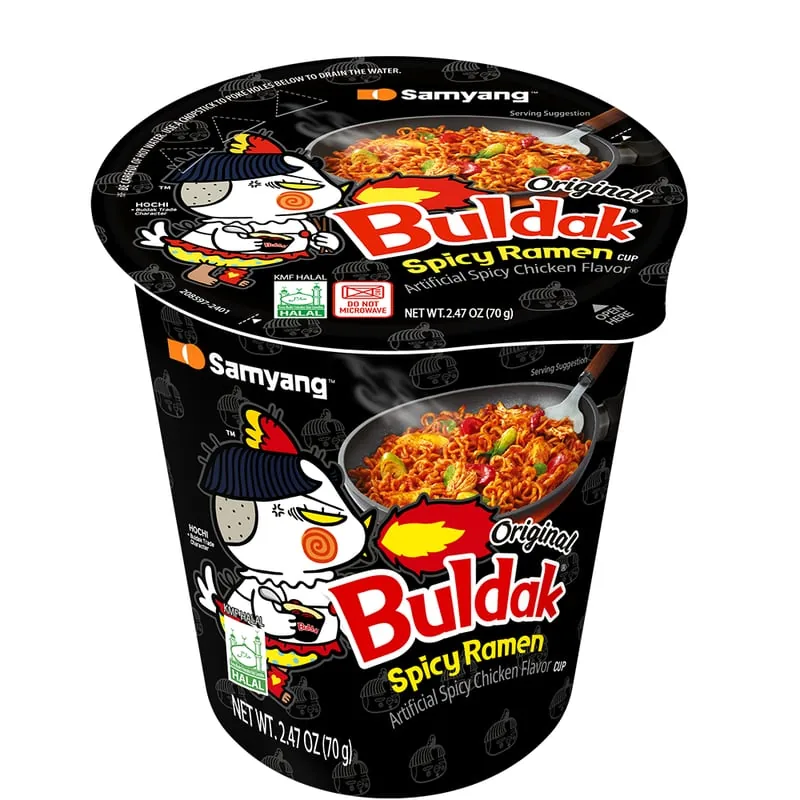

Retail margin is the share of a selling price that remains after the cost of the goods. If a cup of noodles costs you $0.50 and sells for $1.50, you keep $1.00 — 66.7% of the selling price. That figure is your gross margin.
The formula is short. Getting it right in practice is less so, because two things routinely go wrong: retailers confuse margin with markup, and they calculate from the invoice price instead of what the stock actually cost them once it arrived.
This guide covers both. Every figure below is an example, chosen to keep the arithmetic easy to follow: we quote wholesale pricing per enquiry rather than publishing it, we do not set or recommend retail prices, and what a product sells for depends entirely on your market. The method is what transfers — substitute the carton price from your own quotation and the steps are identical.
The two formulas
| Measure | Formula | Calculated against |
|---|---|---|
| Gross margin % | (Selling Price − Cost) ÷ Selling Price × 100 | The selling price |
| Markup % | (Selling Price − Cost) ÷ Cost × 100 | The cost |
Both describe the same gap between what you paid and what you charge. They divide it by different numbers, so they produce different percentages from identical figures.
Why margin and markup get confused
A supplier saying “you can put 100% on this” means markup. A retailer hearing “100%” and thinking margin has misread their position by half.
Using an example unit cost of $0.50 with example selling prices:
| Markup applied | Selling price (example) | Actual margin |
|---|---|---|
| 50% | $0.75 | 33.3% |
| 100% | $1.00 | 50.0% |
| 150% | $1.25 | 60.0% |
| 200% | $1.50 | 66.7% |
Markup is always the larger number. If you need a specific margin, work backwards instead of guessing:
Selling price = Cost ÷ (1 − target margin)
At $0.50 cost, a 50% margin needs a $1.00 price. A 60% margin needs $1.25.
Step one: carton cost to unit cost
Wholesale instant noodles are priced by the carton, but you sell by the unit. Divide:
Unit cost = Carton price ÷ Units per carton
The divisor is the part you can look up before you have a quotation:
| Product | Units per carton | Divide a quoted carton price by |
|---|---|---|
| Buldak 2X Spicy 140g | 40 packs | 40 |
| Buldak Original Cup 70g | 30 cups | 30 |
| Buldak Carbonara Bowl 105g | 16 bowls | 16 |
| Buldak Hot Sauce Original 200g | 24 bottles | 24 |
Carton pricing itself is quoted per order, against the flavours, the quantities and the destination — send us the lines you are considering and the quotation gives you the numerator for this division. Carton quantity is a property of each individual product rather than of the format, so take that figure from the product page for the line you are ordering. How many Buldak packs are in a carton covers the configurations across the range.
Step two: goods cost to landed cost
The unit costs above are for the goods alone. A wholesale quotation normally excludes freight, insurance and anything charged at the destination — those are quoted separately, because they depend on your port, your volume and your country’s treatment of imported food.
Costs that commonly sit between the invoice and the shelf:
- Freight — sea or air, plus origin handling
- Insurance on the consignment
- Import duty and taxes, which vary by destination and by product classification
- Customs clearance and broker fees
- Port and terminal handling
- Inland delivery to your warehouse or store
- Warehousing while the stock sits
- Payment processing on the sales side
- Damaged or unsold stock, which spreads across the units you do sell
- Promotional discounts, which reduce realised price below list
- Currency movement between quotation and payment
Rates differ so widely by route, country and volume that a single set of figures would be misleading. Get real quotations for your own lane and use those.
The arithmetic is straightforward once you have them:
Landed unit cost = (Goods + freight + duty + clearance + delivery) ÷ Units received
A worked example
Buldak Original Cup 70g, 30 cups to a carton. Every figure here is invented — it is not a quotation and not our pricing. Replace the carton figure with the one on your own quotation and the steps do not change.
Goods cost — example only:
- Suppose the carton is quoted at $15.00 for 30 cups → $0.50 per cup
Landed cost — example only:
- Suppose freight, duty, clearance and delivery add $0.10 per cup
- Landed cost: $0.60 per cup
Retail price — example only: $1.50
| Per cup (all figures example) | Against goods cost | Against landed cost |
|---|---|---|
| Cost per cup | $0.50 | $0.60 |
| Selling price | $1.50 | $1.50 |
| Gross profit per cup | $1.00 | $0.90 |
| Margin | 66.7% | 60.0% |
| Markup | 200% | 150% |
The right-hand column is the one that describes the business. Calculating from the invoice price alone overstates the margin by nearly seven percentage points on these figures — and on a thinner line, by enough to make an unprofitable one look healthy.
Both the carton figure and the $0.10 uplift are illustrative. Your landed cost depends on your route and destination; our shipping and delivery page sets out what is quoted separately from goods.
Why a higher price does not always mean more profit
Margin percentage is not the same as money earned. Raising a price lifts margin per unit but usually reduces how many units move.
Using the cup above at its $0.60 example landed cost, example figures only:
| Selling price (example) | Units sold/month (example) | Margin | Gross profit |
|---|---|---|---|
| $1.50 | 400 | 60.0% | $360.00 |
| $1.80 | 260 | 66.7% | $312.00 |
The higher price produces the better-looking percentage and less money. Both numbers here are invented to show the mechanism — the point is that margin and total profit can move in opposite directions, so a price decision needs checking against volume rather than against the percentage alone.
This is why shelf space matters as much as margin. A line at 55% that sells every week can out-earn one at 70% that sits.
Setting a price your market will accept
The formulas tell you what a price yields. They cannot tell you what a price should be — only your market does.
- Establish your true landed cost before anything else.
- Check comparable products in your own market. Instant noodles are a known category with established price expectations, and shoppers compare across brands. What similar imported noodles sell for locally sets your ceiling more than your costs set your floor.
- Work out the margin that price implies, then confirm it covers rent, staff, utilities and card fees with something left.
- Sense-check the formats against each other. Packets carry the lowest cost per portion; cups and bowls cost more per unit but support a higher price point because the customer is paying for convenience.
- Review after a real selling period. Actual turn beats a projection.
Nothing here is a guarantee. Whether a line is profitable for you depends on purchase cost, freight, duties, local operating expenses and your final selling price — variables we cannot see and do not control.
Wholesale considerations that affect your cost
A few purchasing decisions move the landed cost before any of the above applies.
Minimum order quantity. Ours is 200 cartons, applied to the order as a whole rather than per flavour, so one order can mix formats. How the minimum works breaks down what that means in units.
Consolidation. Freight per unit falls as a shipment fills out. Splitting an annual quantity into many small shipments raises the landed cost of every unit.
Range width against depth. Spreading a first order thinly across many flavours leaves too little of each to judge how it sells. Depth on a few proven lines usually reads more clearly.
Shelf life. All our products carry a 10–12 month shelf life from production, which is what makes sea freight practical — transit uses a small fraction of the window. It still needs to be part of the plan if your turn is slow.
Work out your own numbers
Every product in the catalogue lists its pack size, units per carton and carton configuration, and requests a quotation for that line — so you can get a carton price against your own quantities and build a landed cost from it. Compare formats in the packet, cup and bowl guide, or go straight to packet ramen, cup noodles and bowl noodles.
When you have a shortlist, send it through with your destination port and we will quote goods and freight together, so you can calculate a landed cost from real figures rather than estimates.
Frequently asked questions
- What is retail margin?
- Retail margin is the share of the selling price that is left after you subtract what the product cost you. If an item costs $0.50 and sells for $1.50, the $1.00 difference is 66.7% of the selling price, so the margin is 66.7%. Margin is always expressed as a percentage of the selling price, never of the cost.
- How do you calculate retail margin?
- Gross margin % = (Selling Price − Cost) ÷ Selling Price × 100. Use your landed cost — what the stock actually cost you once freight, duty and clearance are included — rather than the invoice price alone, or the figure will overstate your position.
- What is the difference between markup and margin?
- Both measure the same gap between cost and selling price, but against different bases. Margin divides that gap by the selling price; markup divides it by the cost. A 100% markup is a 50% margin. A 200% markup is a 66.7% margin. Markup is always the larger number, which is why confusing the two leads retailers to believe they are earning more than they are.
- How do you calculate cost per noodle pack from a carton price?
- Divide the carton price on your quotation by the number of units in the carton. A carton of Buldak Original Cup holds 30 cups, so a quoted carton price divided by 30 is your goods cost per cup. Carton quantity varies by product — 40 packs, 30 cups, 16 bowls or 24 sauce bottles — so take the figure from the product page for the line you are ordering.
- Are shipping costs included when calculating profit?
- They should be. A wholesale price is normally quoted for the goods alone, and freight, insurance, duty and clearance are quoted separately. Add them to the goods cost to get a landed cost, then calculate margin from that. Margin worked out on the invoice price alone will always look better than the business actually is.
- What margin should a retailer target on instant noodles?
- There is no single correct figure. It depends on your landed cost, your local market's price expectations, your operating costs and how fast the product turns. Rather than copying a target percentage, work out your landed cost, check what comparable products actually sell for in your market, and confirm the resulting margin covers your costs with something left over.