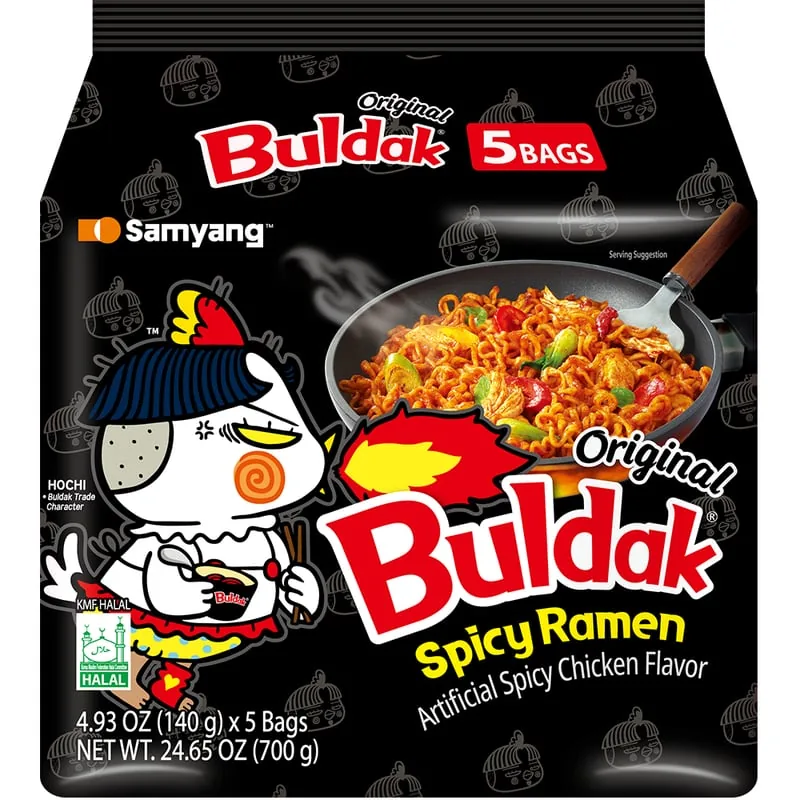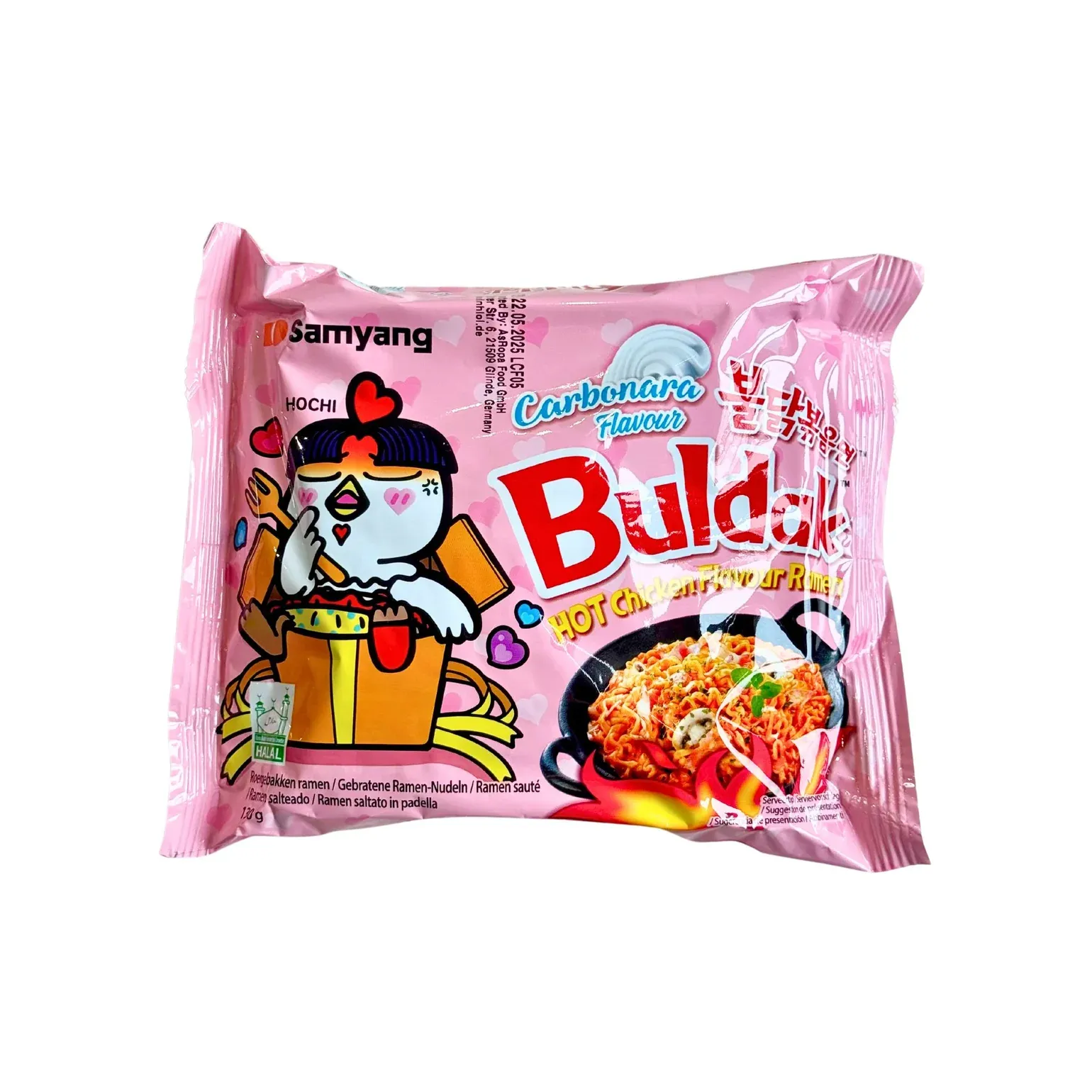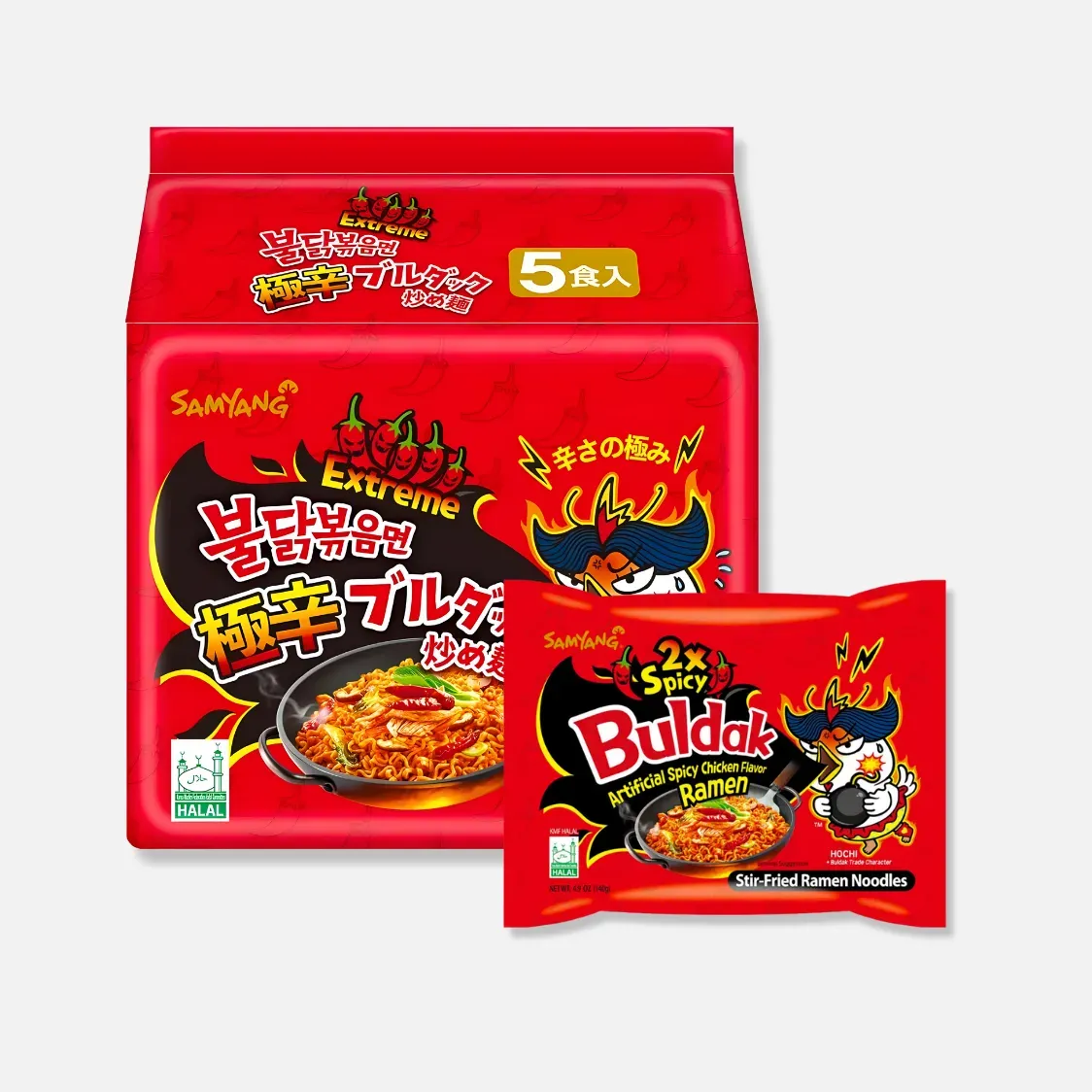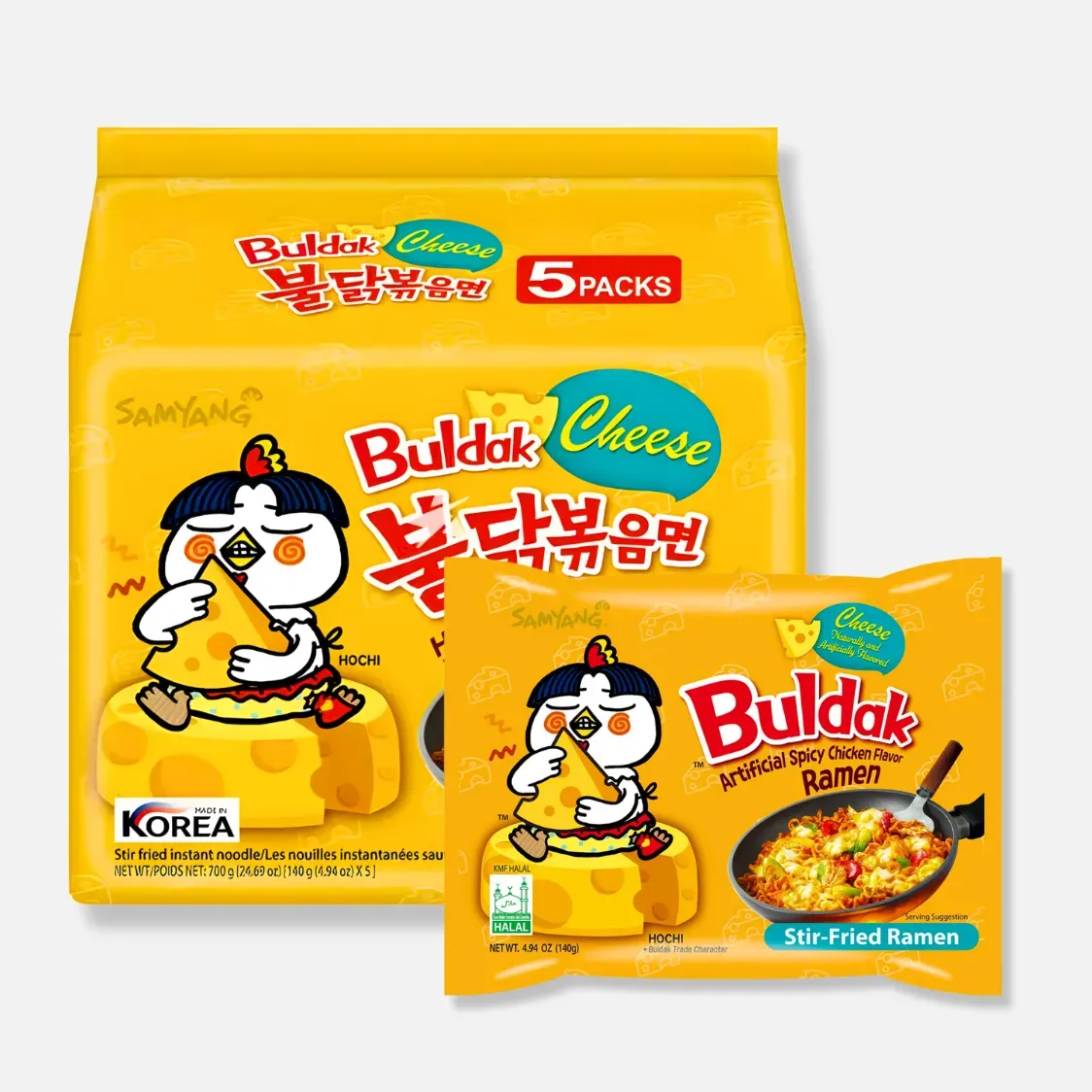
Choosing which Samyang Buldak flavors to buy is a different decision from choosing how many cartons. Quantity is arithmetic. Flavor is a judgement about who walks past your shelf — and getting it wrong is expensive in a way that a quantity error is not, because unsold flavors sit on a 10–12 month shelf life while the ones that move run out.
We supply 56 Samyang products: 21 packet lines, 20 cup lines, 12 bowls and 3 sauces, all manufactured by Samyang Foods Co., Ltd. in South Korea. This article covers ten of the flavors buyers ask about most, what each one actually is, which customers it suits, and how to put them together into an assortment rather than a list.
Two things we will not do. We do not publish sales figures or flavor rankings, because we have no verified data to rank them with. And where the manufacturer’s own description of a flavor is not in our product records, we say so rather than inventing one — four of the ten below fall into that category.
The shape of the range
Every Buldak product is built on one base: a stir-fried hot chicken flavor. The variations either raise the heat — 2X Spicy, 3X Spicy, volcano, extremely spicy — or round it off with dairy, fermentation or sweetness: carbonara, cheese, kimchi, corn, rose.
That structure is what makes assortment planning tractable. You are not choosing between 21 unrelated products. You are deciding how much of your shelf goes to the reference flavor, how much to the softer variants that recruit new customers, and how much to the hotter variants that retain the ones you already have.
Which Buldak flavors should wholesalers stock first?
For a buyer opening the category rather than extending it, the order of priority is usually:
| Priority | Flavors | Why it comes first |
|---|---|---|
| 1. The reference | Original hot chicken | The flavor customers arrive asking for by name. Nothing else substitutes for it. |
| 2. The recruiters | Carbonara, cheese | Dairy-rounded and approachable. They sell to the customer who finds the original too hot. |
| 3. The step-up | 2X Spicy | Retains customers who have already worked through the original. |
| 4. The Korean identity | Jjajang, kimchi | Read as recognisably Korean dishes rather than as heat products. |
| 5. Range extension | Quattro cheese, rose, cream carbonara, habanero lime, stew type | Added once the core is proven and you know which direction your customers pull in. |
This is a sequence, not a ranking of quality. A Korean grocer with an established customer base may legitimately start at tier four. A supermarket introducing the category to a general audience should not.
Availability by format
Flavor and format are separate decisions, and not every flavor is carried in every format. The table below is generated from what we actually supply — the dash means we do not carry that flavor in that format, not that it is temporarily out.
| Flavor | Packet | Cup | Bowl |
|---|---|---|---|
| Original hot chicken | 140g | 70g | 120g |
| Carbonara | 130g | 80g | 105g |
| Cream carbonara | 140g | 80g | — |
| 2X Spicy | 140g | 70g | 105g |
| Cheese | 140g | 70g | 105g |
| Quattro cheese | 145g | 80g | 120g |
| Habanero lime | 135g | 70g | — |
| Rose | 140g | 70g | 105g |
| Stew type | 145g | — | 120g |
| Jjajang | 140g | 70g | 120g |
Two of these flavors are also carried as 200g sauces: the original hot sauce and the carbonara hot sauce. The full range across all 56 products, with pricing, is in the flavour guide.
The ten flavors in detail
Original hot chicken
What it is. The original Buldak stir-fried noodle: a dry, sauce-coated ramyeon with the hot chicken flavor that made the range internationally recognised. It is the reference point the rest of the line is built around.
Who it appeals to. Customers who already know the brand and are looking for it specifically, plus anyone approaching the category through its reputation rather than through a particular flavor.
Segment. Everywhere. Grocery, convenience, speciality Asian retail, online.
Why include it. Because a Buldak range without the original is not a Buldak range. It is the one line where absence is noticed.
Formats. The only flavor here carried in all four — packet 140g, cup 70g, bowl 120g and sauce 200g — so one flavor can cover four channels on a single order.
Carbonara
What it is. A creamy take on the hot chicken base, where dairy richness rounds off the heat instead of amplifying it. The most approachable flavor in the packet range.
Who it appeals to. The customer who wants to try Buldak but is put off by the heat reputation — a large group, and the one most range plans under-serve.
Segment. Grocery and general retail, and any channel where the category is new.
Why include it. It is the recruiting flavor. It converts the shopper who picks up the original, reads the packaging and puts it back down.
Formats. Packet 130g, cup 80g, bowl 105g and a 200g sauce.
Cream carbonara
What it is. A second carbonara variant alongside the standard one. Our product records do not hold a manufacturer flavor description for this line, so we will not characterise it beyond what its name and its place in the range state: it belongs with the dairy-rounded group rather than the heat-led one.
Who it appeals to. The same audience as carbonara, in ranges wide enough to carry two variants of the same idea.
Segment. Retailers with enough facings to merchandise creamy variants as a block rather than as a single line.
Why include it. Only after standard carbonara is established. Two similar flavors in a narrow range compete with each other rather than adding reach.
Formats. Packet 140g and cup 80g. No bowl.
2X Spicy
What it is. The same hot chicken base as the original, built to a noticeably higher heat level. It is the step up buyers reach for once the original is established, and it sells on the challenge as much as the flavor.
Who it appeals to. Customers who have already eaten the original and want more, and the audience that engages with the range through its heat reputation.
Segment. Speciality Asian grocers, online retail, convenience stores with a young customer base.
Why include it. It gives your existing Buldak customers somewhere to go. Without a step-up line, the customer who has outgrown the original has no reason to come back to your shelf rather than someone else’s.
Formats. Packet 140g, cup 70g and a 105g big bowl.
Cheese
What it is. Hot chicken with a cheese finish — a sharper, saltier variation on the creamy theme than carbonara.
Who it appeals to. Younger customers especially, and anyone who reaches for cheese variants across other categories.
Segment. Convenience and grocery retail.
Why include it. It is the second recruiter. Where carbonara softens the heat with richness, cheese does it with salt, and the two together cover more of the cautious-customer spectrum than either alone.
Formats. Packet 140g, cup 70g, bowl 105g.
Quattro cheese
What it is. A four-cheese variant. As with cream carbonara, we hold no manufacturer flavor description for this line, so we describe it only by what is certain: it sits in the dairy-rounded group, and it is the most expensive packet we carry.
Who it appeals to. Customers already buying the cheese line who want the more pronounced version.
Segment. Speciality and premium grocery, where a higher shelf price is supportable.
Why include it. As a trade-up next to standard cheese, not as a replacement for it. It is the highest-priced packet line in our catalogue, which needs a retail price your market will actually carry — worth checking against the method in our guide to calculating retail margin.
Formats. Packet 145g, cup 80g, bowl 120g.
Habanero lime
What it is. A chilli-and-citrus variant. We hold no manufacturer flavor description for this line and no heat rating for any line, so we will not place it on a heat scale relative to the others — its name indicates the direction, and nothing in our data supports going further than that.
Who it appeals to. Customers who follow the range’s newer and more unusual flavors rather than the core.
Segment. Speciality retail and online, where novelty has an audience and shelf space is not the binding constraint.
Why include it. As range extension once the core is settled. It is a reason for an existing customer to look at your shelf again.
Formats. Packet 135g and cup 70g. No bowl.
Rose
What it is. A rosé-style variant, grouped with the flavors that round the heat off rather than raise it. We hold no manufacturer flavor description for this specific line, so that placement — not a taste note — is what we will state.
Who it appeals to. Customers drawn to the creamy end of the range who already have carbonara and cheese.
Segment. Grocery and speciality retail with a developed Korean or Asian aisle.
Why include it. It extends the creamy block without duplicating it, and its 105g bowl is the lowest-priced bowl line we carry — useful where you need a bowl facing at an accessible price point.
Formats. Packet 140g, cup 70g, bowl 105g.
Stew type
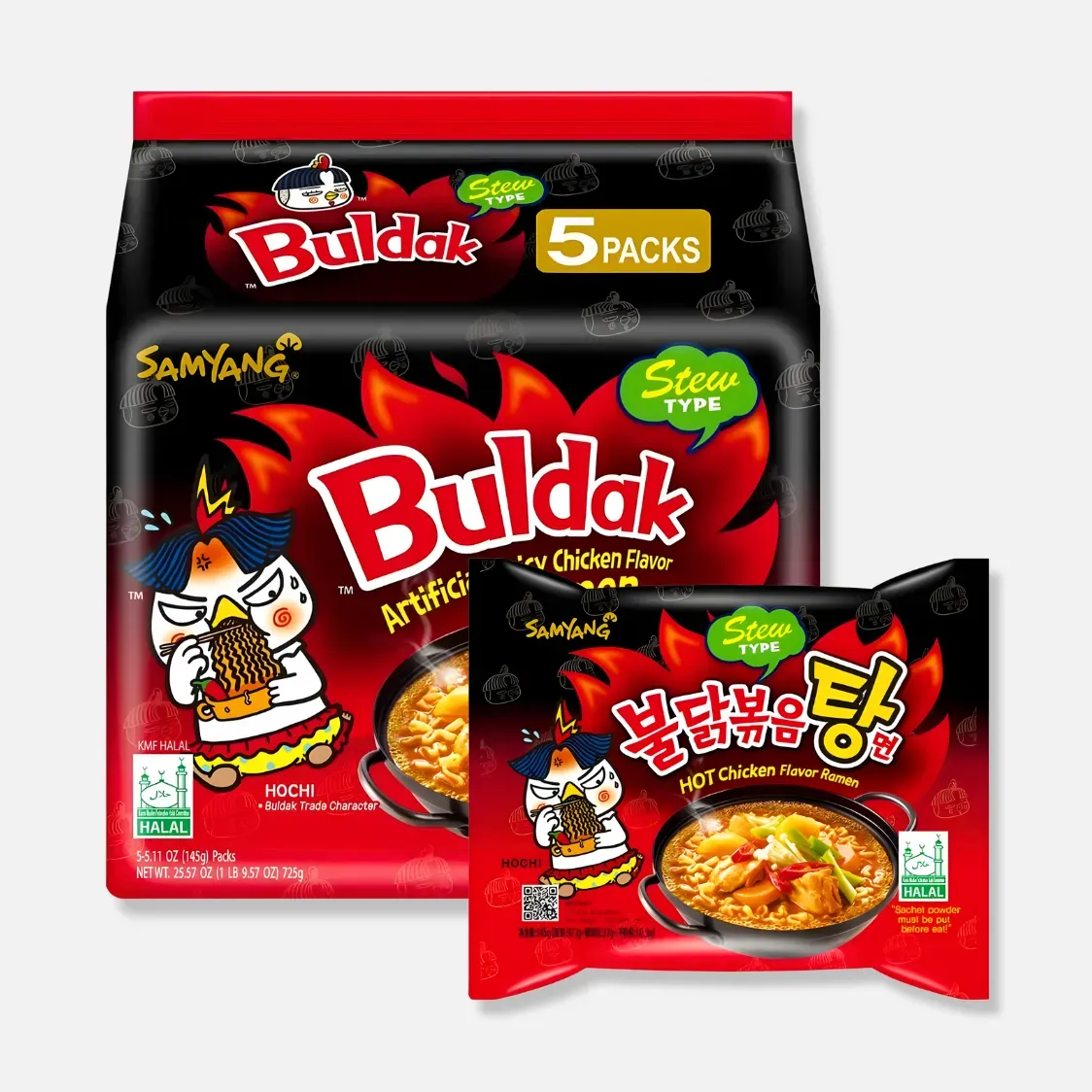
What it is. Unlike the dry stir-fried packets, this is built as a soup — a hot, thick broth rather than a sauce coating. It is the packet to stock for customers who want a bowl of soup noodles rather than a stir-fry.
Who it appeals to. Customers who think of instant noodles as soup, which in many markets is the majority.
Segment. Colder markets, foodservice, and any buyer whose customers ask for soup-style ramyeon.
Why include it. It is the only genuinely different eating occasion in the range. Every other flavor here is a variation on a stir-fried noodle; this one competes for a different meal.
Formats. Packet 145g and bowl 120g. No cup.
Jjajang
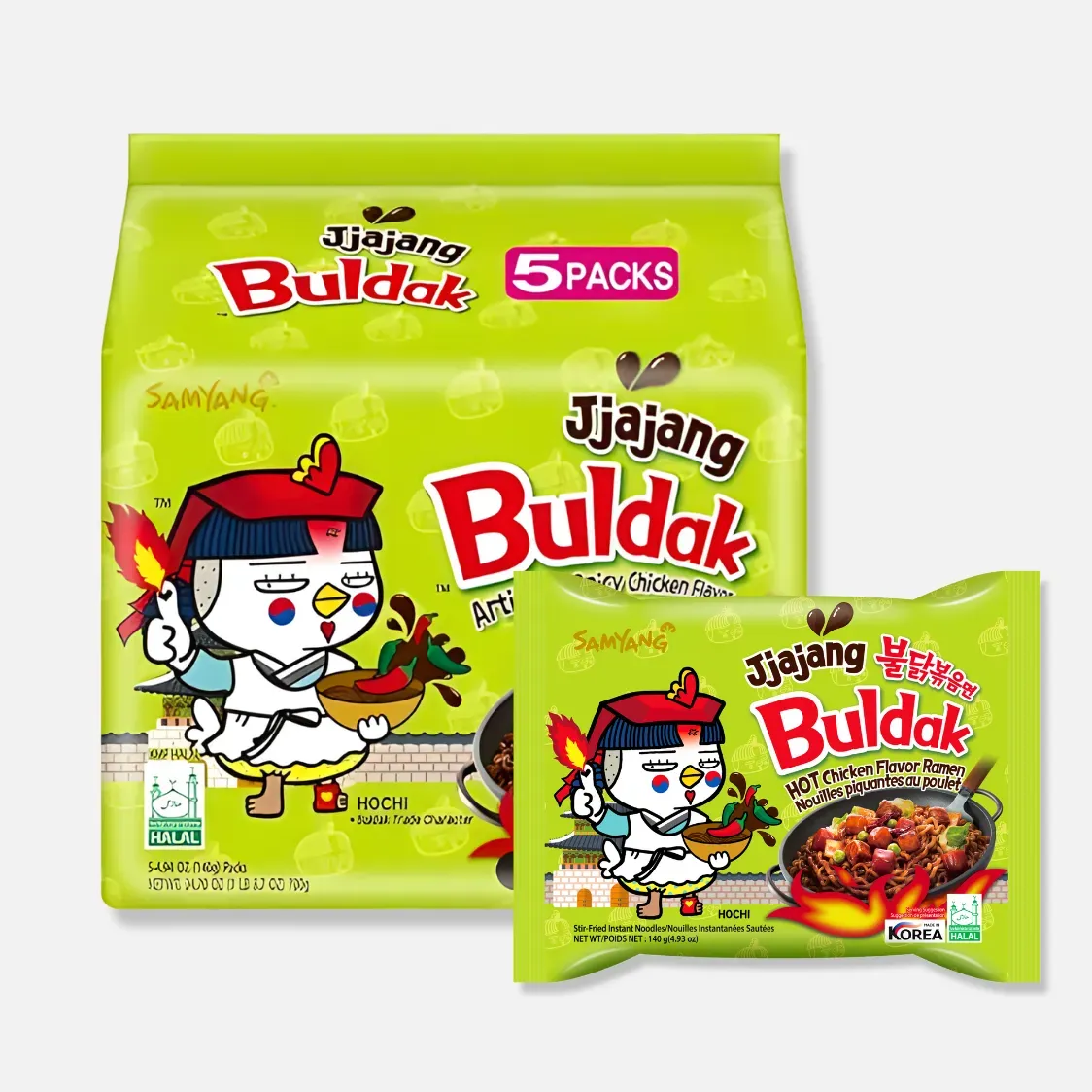
What it is. Hot chicken combined with jjajang, the dark Korean black-bean sauce style. Savoury and slightly sweet rather than purely fiery, it reads as a familiar Korean noodle dish to customers who already know jjajangmyeon.
Who it appeals to. Customers with existing Korean food knowledge, and anyone who wants depth of flavor rather than heat.
Segment. Korean and pan-Asian grocers, and restaurants building a recognisably Korean menu.
Why include it. It signals that your range is Korean rather than simply spicy. For a shelf aimed at customers who know the cuisine, that distinction does more work than another heat level.
Formats. Packet 140g, cup 70g, bowl 120g.
Best Buldak flavors for mainstream customers
If your shelf is read by general grocery shoppers rather than by people who came looking for Korean food, the working set is original hot chicken, carbonara and cheese.
The reasoning is not that these are the best flavors. It is that a mainstream shelf has to answer two different shoppers at once: the one who knows the brand and wants the original, and the one who has heard of it and is nervous. Carbonara and cheese answer the second shopper; nothing else in the range does it as directly.
Worth knowing for the same audience: the corn flavor reads sweet and salty rather than hot, and tomato pasta sits closest to an Italian-style noodle — the most Western-facing flavor in the line, and one that travels outside a dedicated Asian aisle.
Best spicy options
For customers who come to this category for heat specifically:
- 2X Spicy — the standard step up from the original, and the line most heat-led customers name.
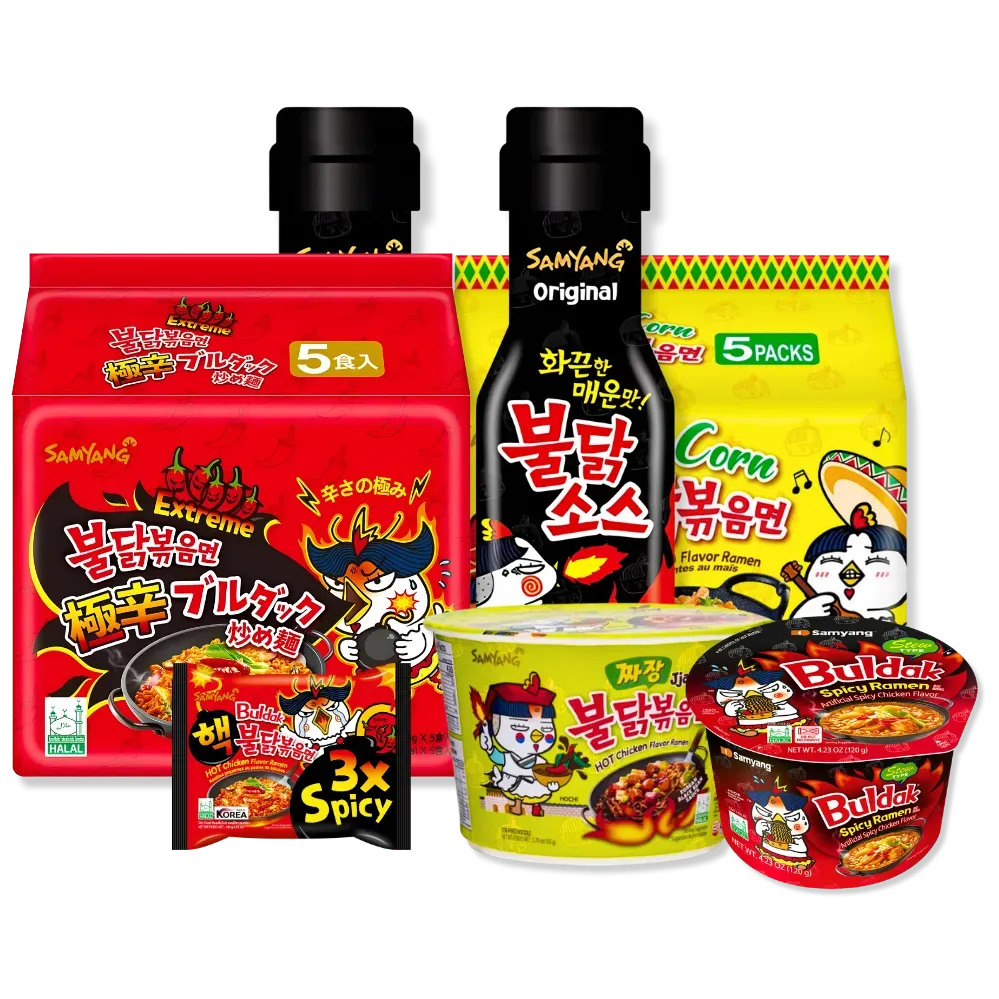
- 3X Spicy — the hottest packet we carry, above both the original and 2X Spicy. It is bought deliberately rather than browsed. Its case configuration differs from the rest of the packet range, so confirm it with us before you build a quantity around it.
- Buldak Hot Sauce Extremely Spicy — the hottest of the three sauces, packed 24 bottles to a carton.
The relative order above follows the manufacturer’s own naming: original, then 2X, then 3X and extreme. We do not publish Scoville figures or heat ratings for any line, because none exist in our product data.
A merchandising point that matters more than the individual choice: heat-led lines work best displayed as a ladder, with the original, 2X and 3X adjacent and in order. The progression is the proposition.
Best creamy and cheese flavors
Carbonara, cream carbonara, cheese and quattro cheese are the mildest group in the range, because dairy rounds off the chilli rather than amplifying it.
For most buyers, two of the four is the right number to start with — carbonara and cheese, which are the most distinct from each other. Cream carbonara and quattro cheese are trade-ups, and they earn their place once you can see which direction your customers actually pull in.
Rose belongs near this block on the shelf even though we hold no flavor description for it, because the range groups it with the flavors that soften rather than intensify.
The commercial argument for the creamy block is simple. It is the part of the range that grows your customer base rather than serving the one you already have.
Best flavors for mixed pallets
The minimum order is 200 cartons, and it applies to the order as a whole — not per flavor, per format or per category. One order can combine packet ramen, cup noodles, bowls and sauces freely. Noodle cartons palletise at 80 per pallet and sauce cartons at 85, so 200 cartons is two and a half pallets of noodles.
Two mistakes recur when buyers build that 200.
Spreading too thin. Two hundred cartons divided evenly across twenty packet lines is ten cartons each — 400 packs of every flavor, including the ones your customers have never heard of. You will run out of three lines and still be holding the rest at month eight.
Anchoring only on novelty. The unusual flavors are the interesting part of the range, but they are the extension, not the foundation.
A worked shape, offered as an example only — your own split depends on your channel and your market:
| Block | Share of a first order (example) | What goes in it |
|---|---|---|
| Reference | Largest single block | Original hot chicken, in your primary format |
| Recruiters | Second largest | Carbonara and cheese |
| Step-up | Moderate | 2X Spicy |
| Korean identity | Moderate | Jjajang, kimchi |
| Extension | Smallest | Quattro cheese, rose, cream carbonara, habanero lime, stew type |
| Sauces | A few cartons | Original and extremely spicy, for cross-merchandising |
The proportions are yours to set. The principle is that depth on a few proven lines beats breadth across many unproven ones, because depth is what keeps a facing filled. Our minimum order quantity guide works through what 200 cartons converts to in portions.
How retailers can build a balanced Buldak assortment
Five checks, in the order they actually matter.
- Cover the reference flavor first. Everything else is optional in a way that the original is not.
- Carry at least one mild option for every heat option. A shelf that is entirely hot sells only to people who already like hot. Carbonara or cheese next to the original changes who can buy from you.
- Match format to how your customer eats. Packets suit grocery, where the shopper cooks at home. Cups and bowls suit convenience and food-to-go, where hot water is all that is available. The format comparison guide covers the commercial differences.
- Decide depth before breadth. Work out how many facings each line needs and how fast you expect it to turn, then convert to cartons — not the other way round.
- Leave room to change your mind. Your second order should not look like your first. Track which lines move and rebalance; the range is wide enough that you do not have to guess twice.
Cross-merchandising the sauces beside the noodles is the cheapest addition available — 24 bottles to a carton, the lowest-priced carton in the range — and it puts the flavor on a shelf where the noodles are not.
What to confirm before ordering
Flavor choice settles what you want. These settle what you get:
- Carton configuration for the exact lines you have chosen — it is a property of the individual SKU, not of the format. Our article on how many packs are in a carton covers the standard configurations and the exceptions.
- Remaining shelf life at shipment for the batch being shipped, in writing. Total shelf life is 10–12 months from production; what reaches you is what is left after transit and clearance, which is covered in shelf life and storage.
- Labelling and import requirements for your destination market, which are yours to confirm with the relevant authority. The Korean instant noodles sourcing guide covers the wider import picture.
- Landed cost per flavor, not invoice cost. Flavors differ in carton price, and a range plan built on goods cost alone will not survive freight.
Pricing and next steps
Every product in the catalogue shows its pack size, units per carton and both per-unit and per-carton wholesale pricing, so you can build a flavor mix and price it before speaking to anyone. The flavour guide puts all 56 products side by side if you want to compare the whole range at once.
When you have a shortlist, send it through with your destination port and we will confirm carton configurations for those specific lines and quote goods and freight together. If you would rather start from the commercial terms, the wholesale buying guide and the ordering process cover what happens after an inquiry.
Frequently asked questions
- What are the best Samyang Buldak flavors for wholesale buyers?
- There is no single best flavor, because the right mix depends on who your customers are. For most buyers the reliable core is the original hot chicken flavor, carbonara and cheese — the reference flavor plus two dairy-rounded options that suit customers who find the original too hot. Heat-led lines such as 2X Spicy and distinctly Korean lines such as jjajang or kimchi are then added according to how established the category already is in your market.
- Which Buldak flavor should a retailer stock first?
- The original hot chicken flavor. It is the reference point the rest of the range is built around and the flavor most first-time customers come looking for by name. Listing a range without it means the shopper who knows Buldak does not find what they came for.
- Which Buldak flavors are the mildest?
- Carbonara, cream carbonara, cheese and quattro cheese are the mildest, because dairy rounds off the chilli rather than amplifying it. The corn flavor reads sweet rather than hot. Among the sauces, the carbonara bottle is the mildest of the three.
- Which Buldak flavor is the hottest?
- In the packet range, Buldak 3X Spicy is the hottest, above 2X Spicy and the original hot chicken flavor. Among the sauces, Buldak Hot Sauce Extremely Spicy sits at the top. The relative order follows the manufacturer's own naming; we do not publish heat ratings, because no verified figure exists in our product data.
- Can I mix different Buldak flavors in one wholesale order?
- Yes. The 200-carton minimum applies to the order as a whole, not per flavor, per format or per category, so a single order can combine packet ramen, cup noodles, bowls and sauces in whatever proportion suits your customers.
- How many Buldak flavors should a retailer list?
- That depends on your shelf space and how fast the category turns for you. The practical constraint is depth: a range spread thinly across many flavors runs out of the ones that sell and carries the ones that do not. Most buyers concentrate volume on a small core and treat the rest as range extension.
- Are all Buldak flavors available in packet, cup and bowl?
- No. Availability differs by flavor. Of the flavors covered in this article, the original hot chicken flavor, carbonara, 2X Spicy, cheese, quattro cheese, rose and jjajang are carried in all three noodle formats; cream carbonara and habanero lime are carried as packet and cup; stew type is carried as packet and bowl. Check the product page for the specific line you intend to order.